Monday, September 20, 2010

New Wave for the New Week #84

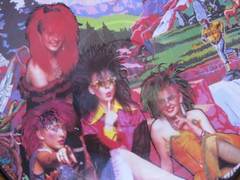
We've Got A Fuzzbox & We're Gonna Use ItImage by Diego's sideburns via FlickrIn Birmingham, England, in 1985, a group of fresh-out-of-high-school girls decided to form a band.  They could play their instruments well enough to get by, but they had a giddy, loopy enthusiasm and a crackling energy that propelled them much further than their amateurish musical talents could have taken them alone. And they had both the neatest gimmick and the most unwieldy band name in history.

When sisters Jo and Maggie Dunne began practicing with Tina O'Neill and Vickie "Vix" Perks, they quickly decided they needed something to set them apart from the crowd.  Sporting multi-colored mohawks, gaudy thrift-store outfits and neon make-up, they had a signature look; now they needed a sound.  They found it in the form of distortion pedals for their guitars, which prompted Maggie to announce to her cohorts, "We've got a fuzzbox, and we're gonna use it!"  Not only did that become the band's statement of purpose, they adopted it as their name as well.

Within a year, We've Got A Fuzzbox And We're Gonna Use It had their first record out on the independent Vindaloo label, the double A-side "XX Sex"/"Rules And Regulations." Both songs were heavy on the distortion, burbling along with chanty cheerleader vocals and very simple arrangements; both were irresistibly catchy.  The single was soon expanded into a 5-song EP, with all five tracks on one side of a 12-inch record; the other side was unplayable, as the band etched self-drawn caricatures of themselves and messages to their fans into the vinyl.

The record sold well enough to get We've Got A Fuzzbox And We're Gonna Use It  noticed by the Geffen label, who rushed them into the studio for their debut album.  Bostin' Steve Austin appeared in mid-1986 in the UK, with the lead single, "Love Is The Slug," receiving a ton of airplay.  Geffen decided to release the record in the US, but they had two changes in mind: first, the title of the album was changed to the band's name. And second, about that name...they'd never get played on the radio with a name like We've Got A Fuzzbox And We're Gonna Use It, so the label had them truncate it to simply Fuzzbox.

That album is wonderful from start to finish.  The band's originals are uniformly enjoyable, hook-filled bits of punky-pop bubblegum. Their cover of Norman Greenbaum's "Spirit In The Sky" is jaw-dropping and not to be missed, and "Love Is The Slug" became a cult favorite and their most well-known song.  They seemed set for big things, but unfortunately the label wasn't done tinkering with the band.

A second album, Big Bang!, was unveiled in 1989, and left everyone scratching their heads. The girls had ditched their signature look in favor of a much more polished, "video-friendly" image. Worse, their was nary a fuzzbox to be heard anywhere on the record.  In fact, the girls did not play a single instrument on Big Bang! Geffen had essentially recast them as Bananarama version 2.0, sapping every last bit of personality from them.  A few of the songs weren't entirely bad: "Pink Sunshine" and "International Rescue" were pretty solid pop songs, but this wasn't what anyone who loved the first record wanted to hear. The only thing remotely reminiscent of the old Fuzzbox was their decision to cover Yoko Ono's "Walking On Thin Ice," and even that turned out to be a better idea in theory than in execution.  A single from what was a planned third album appeared later ("Your Loss My Gain"), but the backlash was too great to overcome, and Fuzzbox called it a day.

Vix went on to record a solo album while the other girls all dropped out of the music world completely.  The two albums fell out of print, but a few "best of" compilations of Fuzzbox songs have appeared over the years, the best being 2004's Look At The Hits On That!!, which collected the early singles and the best songs from the two albums along with a DVD containing all of the girls' promotional videos.

In early 2010, Fuzzbox got back together for a reunion. Only Tina did not join in; in her place they added a new drummer, Karen Milne, and bass player Sara Firebrand and launched a summer UK tour. They also recorded a new single, covering M's New Wave classic "Pop Muzik." Whether a new album is in the works remains to be seen.

This week's NW4NW entry is the clip for "Love Is The Slug," which still remains among my favorite songs and videos from the era. Enjoy!


Enhanced by Zemanta

Monday, September 6, 2010

New Wave for the New Week #82

It's Labor Day, kids.  Last night, temps around here dropped into the 50s (beautiful sleeping weather if you ask me).  The local rugrats are all either back in school or headed back this week.  It all means summer is just about over. Not complaining much about that this year - far too many days over 90ยบ  and 90% humidity for my liking - but it's always sorta sad to see the summer end. So, before the cool breezes turn to jacket weather, how about one more bit of summery fun, in the form of this week's NW4NW?

And what better band to fit the bill than Malibu's own The Surf Punks? The band originally came together in 1976, with a pair of celebrity-related surf-n-sand enthusiasts at the core: Dennis Dragon (brother of Daryl Dragon, better known as "The Captain" of The Captain and Tennille) and Drew Steele (son of Gavin McLeod, better known as Captain Stubing of The Love Boat) began writing and recording in a little garage-based studio across the street from Zuma Beach.  John Heussenstamm and John Hunt rounded out the band, with the late Scott Goddard lending occasional vocals.

They were goofy, wickedly funny, and made great music. Their songs covered the topics they knew and loved best: surfing, tanning, drinking beer and chasing girls. Their incredibly awesome debut album, My Beach (1980), contains classics like "My Beach," "My Wave," "Beer Can Beach," "Teenage Girls," "Big Top," and "Punch Out at Malibu." Deep, intellectual stuff it's not.  But it is the perfect soundtrack to summertime on the beach.  With a sound falling somewhere between The Beach Boys and The B-52s with a strong seasoning of LA Punk Rock and Jeff Spicolli attitude, The Surf Punks were the musical equivalent of the rock-n-roll/T&A movies that used to be shown late nights on the USA Network in the early '80s. The whole thing seemed like it was going to be a one-and-done novelty act record.  Only problem was, someone forgot to to tell that to the band or their fans.

The Surf Punks actually found enough depth in the shallow waters they were surfing to release another collection of songs about surfing, beer and girls in bikinis.  Locals Only was released in 1982 and found a fan base eager for more of this stuff.  Not quite as consistently sharp or funny as the debut, it does have its moments - notably the title track.

After disappearing for a few years, The Surf Punks reappeared on record store shelves in 1988 with Oh No, Not Them Again! and, later in the year, Party Bomb.  They were still mining the same lyrical and musical veins, but the joke was finally wearing thin.  They were now basically a parody of themselves, which is a doubly bad thing when your band was built on the edges of self-parody in the first place.

Nonetheless, those first two albums  remain essential summer listening material.  So, as the summer of 2010 comes to close, we celebrate The Surf Punks in all their glory with two picks: first up, a clip of them performing "My Beach" taken from the movie Urgh! A Music War; after that, an audio-only clip for the second LP's title cut, "Locals Only." Enjoy!


Wednesday, September 1, 2010

Of Ugly Logos and Local Talk

Want to direct your attention to a couple of blog posts recently posted by my friends Daniel Klotz and Kelly Watson regarding Lancaster, PA's recently announced "rebranding," and specifically the lunacy surrounding our fair city's new logo.  Klotz provides a comprehensive timeline that should bring everyone up to date; Watson delved a bit deeper into the logo's *ahem* pedigree, and later gave the design firm that was contracted to create the logo a chance to be heard.

I don't have much to add to their words; among those three posts the story to date is covered efficiently.  I will say that, regardless of where it came from, the new logo is just plain ugly, more befitting the Lancaster that built the concrete monstrosity known as the Brunswick Mall than of a Lancaster that has been casting its hopes for present-day cultural significance among the arts crowd centered around Pennsylvania College of Art and Design and Gallery Row downtown.

As my hometown continues its futile straw grasping in search of some sort of salable identity with which to draw people back into downtown life, I continue to be astounded at, frankly, the stupidity of it all.  For instance, I have yet to have anyone satisfactorily explain to me what "A city authentic" actually means; I do know a city that would splat a cookie-cutter Marriot Hotel within the gutted facade of the beautiful, unique, 100+ year old Watt & Shand building may be a lot of things, but "authentic" isn't one of them.

Enhanced by Zemanta

Tuesday, August 31, 2010

Get Well, Jim!

We never really think about it much, but it truly is frightening how fragile we are, and how suddenly everything - our own world and the world of everyone around us - can change.

I have not talked much on this blog about what I do for a living. I've been in direct marketing, working with the same company, Visions Marketing Services, for nearly 14 years.  For the better part of that time, our focus had been in the home equity and debt consolidation fields, bringing solutions to people in need in the form of our clients' products: refinances, home equity loans, etc.  When the economy went south a couple years ago, we went from being as profitable as we'd been in 30 years to having to lay off 90% of our staff across two divisions, and in fact shutting down one of those divisions - the one I had been running for nearly five years.  I was kept on board and have spent the past two years helping to rebuild the company and  carve out a new path for us.  We are now in the Long Term Care industry, and the vehicle with which we are again reaching out to help people is The Long Term Care Association.

Through the Association, we seek to educate people about the things Long Term Care can do to you, and what Long Term Care Insurance can do for you.  We are a hub for Agents who sell Long Term Care Insurance to find the best resources for transactionally modeled leads, prospect qualification, scheduling appointments with potential customers, and creating proposal. On the consumer side, we offer a way to connect those who wish to learn more about Long Term Care Insurance and find out if it is the right choice with local Agents who are knowledgeable and capable.

Over the past two years, I went from knowing nothing about Long Term Care to learning quite a bit.  There are some startling statistics, but none give as much pause to consider "what if" than this: over 40% of people currently receiving Long Term Care in this country are under the age of 65.

Think about that for a moment.  Most people think of Long Term Care as something they won't need to worry about until they are older, probably well into retirement.  But for 4 out 10, it is something they are dealing with while still in what wold be termed their "working years."
 
This statistic was made all too real for me this morning. Got up and had my usual coffee and cereal, and fired up the computer, preparing for another workday (I work from home most of the time).  My first stops are usually Facebook and Twitter, just to see what has been posted overnight.  It was on Facebook that I learned of an accident that had befallen one of my high school classmates.

Jim Sebest and I did not run in the same circles back then; in fact, Jim was at times among those who delighted in tormenting me.  But at his core Jim always was a good guy, funny and likeable. Apparently, according to the CaringBridge.org website that has been set up for him, Jim and his family were on vacation at Bethany Beach last week, and Jim was enjoying the surf.  He dove into a wave, and the best they can tell is that he hit his head on the sand. He suffered a fractured vertebrae in his neck, and is presently paralyzed from the neck down.  The good news is that, after undergoing 8 hours of surgery on Friday, his doctors saw no signs of severing or lacerations of the spinal cord, but there is severe swelling and no telling how long that will last.

I had just seen Jim for the first time in 25 years at our Class Reunion in July.  I didn't get to talk with him much - as I said, we didn't run with the same crowds - but despite showing the same signs of being 40+ that we all shared, he seemed to have barely changed.  He was laughing and joking with friends, and had taken part in the Reunion Golf Outing that morning.  Less than a month later, he's in a hospital bed, unable to move or speak and needing a ventilator tube to breathe.

With a little luck, and the thoughts, prayers, love and support of his family and friends, Jim will recover.   Having no indication of severe spinal cord damage means his chances are excellent to regain full mobility.  Think for a moment of those who have had similar accidents, but whose luck was worse.  Think of those who will never recover, those who will spend the rest of their lives unable to move, speak, or breathe on their own. Think of how their lives are changed - how your life would be changed if it happened to you.  Jim was a classmate of mine, so we're roughly the same age, yet I never think of myself as someone who may need Long Term Care in the near future.  At least, I never really thought about until today.

Jim, all my best thoughts and prayers go out to you and your family, and I wish for you a speedy recovery.  I want to read about you leaping up out of that bed very soon.
Enhanced by Zemanta

Monday, August 30, 2010

New Wave for the New Week #81

Bursting out of LA (via Dallas) in 1981 in an explosion of reedy synthesizers, go-go boots, Aqua Net and all the best parts of every Shangri-La's record ever, cracking her pink bubblegum and winking at all the boys, Josie Cotton was - and still is - the ultimate New Wave chick. Her debut album is a nearly perfect artifact of its time; her comeback twenty years later proved she still had the "It-Grrl" factor that her New Wave Girl contemporaries like Dale Bozzio, Terri Nunn and Belinda Carlisle either lost along the way or cast aside in hopes of winning Music Industry approval. Working in tandem with her husband, Geza X, she continues making excellent music today. 

The former Kathleen Josey left Dallas for LA in 1980, and within a year had already made a very loud splash on the scene with her debut single.  Choosing to record a song that was originally meant for but turned down by The Go-Go's, Josie released "Johnny Are You Queer?" as a one-off single for Bomp! Records.  The shock value of the song's lyrics (which seem so incredibly tame today) and built-in controversy got the record a great deal of notice, and Elektra Records snapped up her contract in a flash and rushed her into the studio for a full LP.

1982's Convertible Music is, as noted earlier, nearly perfect, and is utterly necessary to any New Wave record collection.  "Johnny" is included, along with bubbly boppers like "So Close," "Systematic Way," and a nifty cover of The Exciter's "Tell Him." The centerpiece of the album, though, is the wonderful "He Could Be The One," which, although stalling at #74 on the Billboard Hot 100, climbed to #34 on the Billboard Rock chart and was Josie's biggest-selling single (it was also a rare instance of a US single being released mainly on colored vinyl - bubblegum pink, of course.)

Josie became known to a wider audience through her exposure in the 1983 movie Valley Girl, in which she performed both of her hits in addition to an otherwise unreleased cover of Gary U.S. Bonds' "School Is In."

A second album, From The Hip, hit the shelves in 1984 boasting another excellent single, this time a cover of The Looking Glass's "Jimmy Loves Maryann," after which Elektra chose not to renew her contract, and Josie seemed to fade away.

Almost a decade later, in 1993, a French import album called Frightened By Nightingales appeared, credited to "Josey Cotton."  Sounding quite unlike her previous material, this first attempt at a comeback didn't quite catch on, even with diehard fans.  Reverting to the more familiar spelling, Josie and Geza co-founded B-Girl Records and focused on production work, until a wonderful new Josie Cotton album appeared in 2005. Movie Disaster Music revealed a grown-up version of the Josie Cotton we all knew and loved.  Now this was more like it!  The comeback was sealed, though, with 2007's Invasion Of The B-Girls, a wonderful collection of covers of themes and songs from assorted cult movies from the 1960s, led by the utterly fantastic version she recorded of "Maneaters (Get Off The Road)," originally credited to The Faded Blue in Herschel Gordon Lewis' 1968 schlock-fest She Devils On WheelsInvasion is another must-have album, every bit as wonderful as Convertible Music had been 25 years before it.  A new album, Pussycat Babylon, is scheduled for release in October, and can be pre-ordered through Amazon.com now.

For a little compare and contrast fun, here are a trio of Josie Cotton clips - first, an audio-only clip if her shocking debut, 1981's "Johnny Are You Queer?"  Then, from the same era, a clip of Josie performing with surf legends The Ventures on the classic "Secret Agent Man."  Finally, representing present-day Josie, the promo clip for "Maneaters (Get Off The Road)."  


Enhanced by Zemanta

Monday, August 23, 2010

New Wave for the New Week #80

The music world is full of talented people capable of creating mesmerizing music and songs that leave you wanting more. Of those, a certain subset become so enamored with themselves and their own talent that they begin to believe every idea they ever have is brilliant and should immediately be captured in the recording studio lest the world be deprived of that brilliance, and where once was an inspired and inspiring musician now sits a pretentious twit no longer capable of separating the good ideas from the crap (Hello Bono! Hello Sting!).

Standing at the front of that line is Welsh-born singer/songwriter Julian Cope. Cope began as one third of a band now far more revered for what its members did afterward than for anything they actually did at the time.  The Crucial Three (ah, see the early seeds of pretension already?) was Pete Wylie, who would go on to form the band Wah!, Ian McCulloch, who would become a star as frontman for Echo & The Bunnymen, and our good Mr. Cope, who upon leaving The Crucial Three made his greatest and least self-congratulatory contributions to the New Wave via his band, The Teardrop Explodes.

Nicking their name from a Marvel Comics panel (Daredevil #77, for those of you who crave such minutiae), The Teardrop Explodes joined bands like Echo & The Bunnymen, The Associates, The Sound and The Chameleons in a swiftly growing scene of retro-psychedelic UK bands beginning to make noise in the early '80s.  Cope's moody, eccentric lyrical imagery and stabs at literary reference, which might have been clunky at best in virtually any other setting, meshed beautifully with the shimmering, soaring melodies of early singles like "Sleeping Gas" and "Bouncing Babies" (both 1979).  In fact, the latter single may have truly triggered Cope's belief in his own hype, it being a rare instance of one band's single being the subject of a song written by another band (in this case, "I Can't Get 'Bouncing Babies' By The Teardrop Explodes" by The Freshies).

Cope was a demanding and exacting frontman - and, as often goes hand-in-hand with such, an exasperating one as well.  Before the band's first album, Kilimanjaro, was even recorded, keyboardist Paul Simpson had had enough, and was replaced by David Balfe. Released in mid-1980, the album proved hugely popular in the UK, with singles "Reward" and "Treason (It's Just A Story)" both charting well.  Despite apparently hitting on a winning formula, the band went through no less than half a dozen personnel changes between the release of Kilimanjaro and the recording of the second album a year later!

Wilder appeared in 1981, and while also quite a good album, it was an album created by nearly an entirely different band.  Cope's ego was beginning to run amuck: while the first album's material was the combined effort of united band, this album's songs were all Cope's solo compositions.  No longer allowing others to temper his product, Cope's creations ranged from excellent ("Passionate Friend") to terrible ("The Great Dominion") to downright silly ("Window Shopping For A New Crown Of Thorns").  The band's popularity slipped noticeably.  By the time a third LP was in the planning stages, more changes in personnel occurred, reducing the band to the core trio of Cope, Balfe and drummer Gary Dwyer.   Mid-way through the recording sessions, Cope fired Balfe and Dwyer and officially dissolved the band, shelved the tapes, and decided to do it all himself.

Cope as a solo artist proved to be utterly unbearable.  Think of B-level Sting after the dissolution of The Police, only with even fewer good ideas and even more belief that everyone needs to hear what he has to say.  Cope floundered towards a goth audience, but they already had ex-Bauhaus leader Peter Murphy doing the morose intellectual act; the rise of Robert Smith with The Cure and Morrissey with The Smiths rendered Cope utterly redundant.

Nonetheless, for a brief shining moment, Cope got it all right.  This week's NW4NW clip captures Cope at his best.  Enjoy The Teardrop Explodes' finest single, "Treason (It's Just A Story)":


Enhanced by Zemanta

Friday, August 20, 2010

R.I.P. Michael Been (1950-2010)

Michael Been, lead singer of The Call, passed away yesterday after suffering a massive heart attack backstage at the Pukkelop Music Festival in Hasselt, Belgium.  He was only 60 years old.

At the time, Been was working as a sound engineer for his son's band, Black Rebel Motorcycle Club, but his greatest fame came as the frontman for a band that more than one critic described as an "American U2."   While always respected from within the music industry (Peter Gabriel, Robbie Robertson and even Bono himself were counted among their fans), The Call never quite reached the level of commercial success that their potential seemed to warrant.  They touched the brass ring a few times, however: bolstered by heavy airplay on MTV, 1983's classic "The Walls Came Down" reached the lower rungs of the Top 40; during the 2000 Presidential Campaign, candidate Al Gore used The Call's 1989 single "Let The Day Begin" as his theme song.

Been also dabbled in acting, most notably playing the role of the Apostle John in Martin Scorsese's 1988 film The Last Temptation of Christ.

Among my circle of friends, The Call did achieve their rightful status as superstars.  I was only a sophomore in high school when "The Walls Came Down" hit the airwaves, but from the start it found a home on my short list of all-time great songs.  With its hummably insistent riff (da-da-da-DA, da-DA-da), great lyrics, and four-note guitar solo, the song became a favorite among not only my clique, but most everyone I know who has ever heard it.

The album from which it came, Modern Romans, is as good an introduction to the band as you'll find.  Side One is nearly perfect, with "Walls," "Turn A Blind Eye", "Time Of Your Life" (Been does a scarily accurate Jim Morrison on that one), the title track, and the stark "Back From The Front," its a flawless setlist.  Side Two starts to show evidence of The Call's fatal flaw: they tended to load their LPs front-heavy with the best material, with the weaker tunes closing out.  Rather than mixing the filler in to allow context to bring the best out of it, this approach tended to underscore the lesser songs.  The lone exception was 1986's Reconciled, which found that proper mix (although it still led with its strongest track, "Everywhere I Go.")

When they hit their mark, however, no other band could hold a candle to them.  They released eight albums in total, calling it quits after 1990's Red Moon.

In honor of Michael Been, I've chosen the clip for "The Walls Came Down."  (The clip cannot be embedded here, so please follow the link to YouTube when you click on the image below.) You'll spot The Band's Garth Hudson guesting on keyboards here, and you'll be singing the riff in your head for weeks. Goodbye Michael. You will be missed.


Monday, August 16, 2010

New Wave for the New Week #79

As we all do so often, I found myself the other day in a situation where, not long after a particularly frustrating interaction with another person - but certainly after the moment had actually passed - I thought of the perfect thing I should have said. I hate that.  Here I stood with this wonderfully clever and bitingly witty, searingly sarcastic retort, about five minutes too late.  The French call it esprit d'escalier, which translates to "the wit of the staircase." Literally, the thing you think to say as you are leaving down the stairs from the situation where you should have said it.  The only thing more infuriating is that friend we all have who seems always to have that perfect thing to say at the tip of his or her tongue right at the exact moment to say it.  They have the wit, they have the sarcasm, they have the timing, and they know it.  If that friend were a band, he'd be The Monochrome Set.

Well before Adam Ant brought Antmusic to unsuspecting world, he had been in an art-school band called The B-Sides with Hornsey School of Art classmates Ganesh "Bid" Seshadri, Lester Square and Andy Warren.  Much as Adam's first set of Ants would do years later to form Bow Wow Wow, so too did Bid, Square and Warren abandon The B-Sides in the late '70s to form The Monochrome Set. (Though he made some excellent music in those days, it seems Adam Ant did not play well with others!)

The Monochrome Set's sound is the sound of cool.  Their ridiculously hummable tunes flow as smoothly and sweetly as honey, reminiscent of Bacharach and David's catchiest '60s lounge-pop.  Bid's foggy velvet vocals slide perfectly over top this musical bedding, projecting images of high-class yet smokey nightclubs filled with bored-looking patrons scarcely deigning to converse with one another.

And oh! that wit: From clever song titles ("I'll Scry Instead") to incredibly erudite lyrics ("Don't dance the polka in a dhoti/And whistle the Rite of Spring/Don't recite Hamlet's soliloquy/While munching onion rings" from "Ten Don'ts For Honeymooners"), all of which are delivered in the same laconic, off-handed style, The Monochrome Set affected the perfect too-cool-to-care stance that would normally piss people off, if only they weren't so damned funny.

From 1979 through 1985, The Monochrome Set issued five albums and several singles worth of material, with 1982's Eligible Bachelors being the best of the bunch and a fine jumping-in point for those unfamiliar with the band (although you can't go wrong with any record with their name on it).  There are also a few best-ofs and singles collections which serve as both introduction to and history of the band.

After a five-year hiatus, they returned to the record racks in 1990 with Dante's Casino, released at first only in Japan, where the band had always been hugely popular. When that album's import sales proved the audience was still there, several more albums followed.  The band finally called it quits in 1998, although their website indicates plans for reunion gigs in February of 2011.

This week's NW4NW entry comes from The Monochrome Set's 1982 masterpiece Eligible Bachelors. Here is the clip for "The Jet Set Junta" - enjoy!


Enhanced by Zemanta

Friday, August 13, 2010

I've Got Nothing To Say, But It's OK...

You may have noticed lately that things have been pretty quiet around here.  Other than the weekly NW4NW posts, I haven't written much, and for awhile I was chiding myself pretty harshly over it.  "You gotta write! You MUST write! How can you call yourself a writer if you don't write?  Look at all your blogging friends - they write.  Why aren't you writing?"

So I'd sit at my desk and stare at the blank screen, which returned the stare with its stark, unblinking white emptiness.  I lost that staring contest every time. The distractions were too easy. "Hmm, maybe I need some music. No, that's too loud.  This one's too quiet. Hey, when did I get that CD?" One song would remind me of another then another then another, and suddenly I wasn't writing - I was listening to music!

"OK, back to it," I'd command myself.  But first, a sandwich.  Brain needs energy, right?  Of course, the kitchen is downstairs from my office, which means a trip through the living room and the combined dining room/library (don't ask), which means a quick side trip to make a sandwich turns into half an hour or more because "I'll just see if there's anything worth watching on TV for a moment," or "I really need to read another chapter of the book I'm in the middle of," or whatever.

As you can see, I may fancy myself a writer, but I am far from a disciplined one.

I do employ some helpful tools and exercises.  There is a wonderful website called Write Or Die where you set a goal of writing x number of words in x number of minutes, and the timer starts and you better start writing, because if you don't hit your word goal you receive a penalty that ranges anywhere from "Gentle" to "Electric Shock."  I find it immensely helpful in just getting the flow of words to paper going, even if all I spit out is meaningless gibberish (which, more often than not, it is, but it's about the process, not the content).

When it's content I want to hone, or I start feeling like I'm getting far too verbose, Six Word Stories becomes a source of inspiration.  The idea is to tell a complete story using no more or less than six words.  A personal favorite from the site: "Woman eats horse. Dies, of course."

There are a number of sites out there that offer up random writing prompts or initial sentences to build upon, and trying to write extemporaneously using those prompts can sometimes help me get going, but I don't use those often.  Some folks find them very useful; I find them to be too much like an assignment, which takes the joy right out of writing for me most times.  No, I'm one who needs the inspiration to come from within.  For that reason, I keep a notebook on the nightstand by my bed, as well as scraps of paper throughout the house. Never know when one of those light bulbs will suddenly click on.  I have, at times, sat bolt-upright in bed in the middle of the night and scribbled down a nearly complete blog post, needing only to transcribe it and do some minimal editing the next day.

Recently, though, those notebooks and scraps of paper have been empty.  No inspiration.  Until the other day, when I realized that there really wasn't a problem.  There was no need to scold myself or fear that the writing muse had left me altogether.

That realization was triggered by a line from an old movie I was watching, 1973's The Paper Chase, in which the lead character, Hart, is a first-year law student studying under a demanding and intimidating contract law professor, Kingsfield.  Kingsfield calls on Hart to analyze a particular case, and Hart, seeking to assert a newly-found confidence in his relationship with the professor, replies that he respectfully passes on the opportunity to do so.  "I have nothing to add at this time," Hart boldly explains, "When I have something relevant to say, I shall raise my hand."

And that sums up where I have been in relation to this blog recently: I quite simply have not had anything to say.  Nothing has spurred me to write.  I have not suddenly awoken inspired; I have not had the sudden light bulb moment in some time.  And there's nothing wrong with that.  In fact, it's probably better than me attempting to prattle on about something toward which I feel no particular inspiration.  And when I do have something worthwhile to say, I shall do so.

In the interim, continue to enjoy the weekly NW4NW posts.  There are some other goodies coming as well, but we'll let them be a surprise.  For now, I have nothing else to write.
Enhanced by Zemanta

Monday, August 9, 2010

New Wave for the New Week #78

“Look man, I’m no cheapskate Elvis Costello. I’ve never tried to impersonate him. For a start, we’re more humorous, more tongue-in-cheek than him. He’s more bitchy and venomous, like a middle-aged child.” - Nick Watkinson of The Jags (source: Magnet Magazine)

The Jags were a band that suffered unjustly as a result of their initial success.  Over the course of their four-year existence, these six fellows from London gave the world two albums and one of the most fantastic debut singles of the era; however, the very song that brought them their greatest renown also cast the shadow that stunted the growth of their career.

Formed in 1978 and signed to Island Records by 1979, Nick Watkinson, John Alder, Steve Prudence, Alex Baird, Michael Cotton and Patrick O'Toole saw their very first single, "Back Of My Hand (I've Got Your Number)," spend 10 weeks on the UK pop charts and peak at number 17.  With its jangly guitars and stop-start verses, the song was a bona-fide hit and seemed destined for even greater chart heights.  Unfortunately, there was this fellow named Elvis Costello who had been hanging around the charts for a couple years already, and who had become the darling of the music mags and appointed King of the New Wave of by rock critics everywhere.  Didn't this upstart band's record sound suspiciously like Costello?

The short answer was, yes, in many ways, it did.  The lyrics certainly weren't at Costello's level of skewering wordplay (who else's were?!?), but Watkinson had a voice that veered very close to E.C.'s and a penchant for Costello-esque phrasing.  Close your eyes and listen to Watkinson deliver the final line of the first verse ("you wouldn't phone those guys who mess around wit' choo") and, damn, that almost could be Elvis himself!

By the time The Jag's first LP, Evening Standards, hit the shelves, the unnecessary backlash had begun.   The critics were bound and determined that no one should approach the throne of Costello, and wrote The Jags off as a poor imitation.  Never mind that nothing else on the album sounded like Costello, but was in fact solid power pop material that by all rights should have gone over big.

Their second album, the brilliantly titled No Tie Like A Present, came along a year and a half later, but was a pale imitation of the first record.  You can hear the band struggling to distance themselves from the Costello-imitator tag even further, resulting in a self-conscious paint-by-numbers record of solid but uninspired pop rock.  When the album failed to sell, The Jags called it a day. (Both albums in their entirety, along with a few bonus tracks, were combined for a 2001 CD, The Best Of The Jags)

Really a shame, because that first single remains one of the most enthusiastic and enjoyable records of the time, and the clip below captures the band in those heady early days when their potential seemed limitless. Enjoy this week's NW4NW entry, "Back Of My Hand (I Got Your Number)" by The Jags:


Enhanced by Zemanta